Incident Reporting Is Now a Commercial Event, Not a Technical One
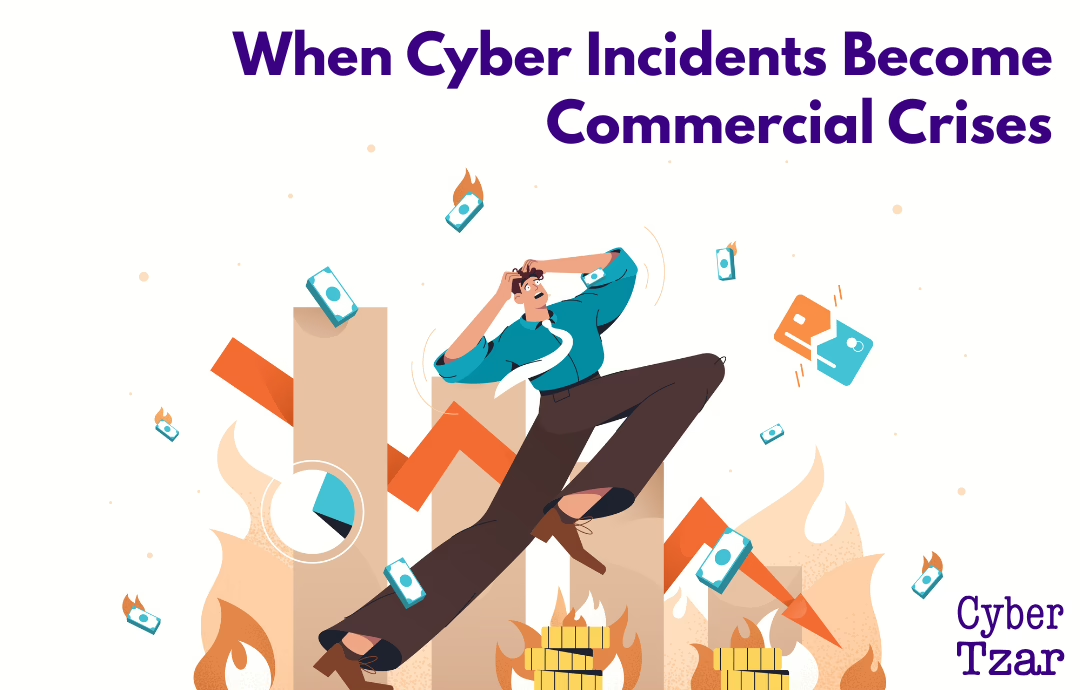
Under the UK Cyber Security and Resilience Bill, incident reporting stops being a back-office technical obligation and becomes a front-stage commercial event.
This is one of the most underestimated shifts in the new regime.
For many organisations, the technical aspects of incident response are already challenging. The Bill does not make those easier — but it adds customers, regulators, contracts and reputation into the critical path, under compressed timelines.
What actually changes
The headline obligations are well known:
-
initial regulatory notification within 24 hours,
-
full reporting within 72 hours,
-
mandatory customer notification for managed service providers and digital services.
What is less appreciated is how these obligations collide in practice.
An organisation may now have to:
-
assess technical impact,
-
decide regulatory significance,
-
identify affected customers,
-
notify regulators,
-
notify customers,
-
preserve evidence,
-
and manage communications,
all while systems may still be unstable and facts incomplete.
This is no longer a purely technical exercise.
Why reporting becomes commercial
Once customer notification is mandatory, an incident:
-
affects contracts,
-
triggers SLAs,
-
raises liability questions,
-
and influences customer trust in real time.
Customers will not experience this as “your internal security issue”.
They will experience it as their operational risk.
In regulated supply chains, customers may also have their own reporting duties — which now depend on your accuracy, timing and judgement.
That dependency creates immediate commercial consequences.
The risk of getting it wrong
The Bill does not require perfection — but it does require timely, reasoned and defensible decisions.
Risks include:
-
under-reporting and later regulatory challenge,
-
over-reporting and unnecessary customer alarm,
-
inconsistent messaging between regulators and customers,
-
and evidence gaps created by rushed or poorly coordinated response.
For suppliers and MSPs, the reputational impact can be more damaging than any fine.
Why most organisations are not ready
Many incident response plans assume:
-
a contained technical response,
-
internal decision-making,
-
and time to stabilise before communicating externally.
Under the new regime, those assumptions break.
Common gaps include:
-
no clear ownership of regulatory notifications,
-
no agreed thresholds for customer communication,
-
no coordination between technical, legal and commercial teams,
-
and no rehearsal of incidents that involve customers and regulators simultaneously.
The first real incident becomes the first real test — and that is a bad place to learn.
Incident response now needs governance, not just tooling
Tools matter. Detection matters. Monitoring matters.
But under the new regime, governance matters just as much.
That means:
-
clear authority to make reporting decisions under uncertainty,
-
pre-agreed customer notification pathways,
-
alignment between legal, technical and commercial teams,
-
and board awareness of how incidents now play out.
Incident response is no longer just an operational capability.
It is an organisational one.
The uncomfortable reality
The Bill does not punish intent.
It exposes fragility.
Organisations with limited capacity, unclear governance or weak coordination will feel the pressure first — not because they are careless, but because the system now assumes readiness based on impact.
That is the commercial reality of modern cyber regulation.
The practical takeaway
If you have not:
-
rehearsed a 24-hour reporting decision,
-
mapped customer notification dependencies,
-
or tested incident response as a commercial scenario,
you are not ready for the new regime — regardless of your technical controls.
Call to action
If an incident would force your technical team, legal advisors and customer-facing staff to coordinate decisions in real time, you need to test that now, not during a live event.
Contact Cyber Tzar to assess your incident reporting readiness — including regulatory timelines, customer notification and commercial impact — before your first incident becomes your first rehearsal.