
Cyber Tzar’s Growth Since 2025
When Fubra backed Cyber Tzar in 2025, we were still proving what the business could become.
The technology worked, we knew the problem around supply chain cyber risk was real, and we had started to show that organisations wanted a clearer and more measurable way of understanding cyber exposure.
What we had not yet built was the business around it.
Looking back, the investment came at exactly the right time. It gave us the confidence and capacity to strengthen the team, improve the commercial side of Cyber Tzar and invest properly in the infrastructure needed to support larger customers and more complex use cases.
A very different business from 2025
The Cyber Tzar of today is materially different from the company Fubra first backed.
Our team grew from two people to 23, adding capability across technology, operations, customer success, commercial development, finance, governance and strategic partnerships.
That was never about headcount for the sake of it. It was about building the capability needed to support a much larger customer base, partner network and technology estate.
Today, Cyber Tzar’s data estate represents approximately 7.4 million organisations, with more than 300,000 organisations under continuous monitoring.
That changes what we are able to do. Rather than simply giving an organisation a point-in-time assessment, we can start to understand how cyber risk changes over time, compare businesses consistently and look at risk across entire supplier populations, sectors and wider business groups.
A clearer product vision
As the business has developed, the product vision has become much clearer.
We are now building around three connected capabilities.
The Score provides a clear 1–1,000 cyber risk score supported by evidence and practical explanation.
The Index enables cyber risk to be compared across sectors, regions, supply chains and national business populations.
The Platform gives organisations the environment to monitor suppliers, manage assurance and coordinate improvement.
Together, they form the foundation of our longer-term ambition: the Universal Cyber Risk Score.
The idea behind it is simple. Cyber security is complex enough already. Our job is to make risk easier to measure, understand and act on.
The financial picture has changed too
Our most recent Companies House-filed accounts cover the year ending 31 March 2026, so they are already a snapshot of where the business was several months ago.
Even so, they show how quickly the underlying position had strengthened.
Net assets increased from approximately £157,000 to £316,000, while total assets less current liabilities increased from approximately £158,000 to £392,000. Intangible assets also increased from approximately £246,000 to £441,000 as we continued investing in the technology and intellectual property behind the platform.
What is more interesting to me is what has happened since that March year-end.
We have already generated more than twice the revenue achieved during the whole of the previous financial year, despite still being part-way through the current reporting period.
That is probably the clearest sign that the investment did what good early backing should do: it gave us the ability to build for growth rather than simply operate month to month.

The biggest commercial change came in 2026
One of the biggest lessons for me over the last year has been around how we take the platform to market.
At the beginning of 2026, our commercial pipeline was approximately £100,000 and we were still heavily reliant on direct sales and individual opportunities.
Since May 2026, we have deliberately built a reseller and strategic partner model around Cyber Tzar. In only a few months, that network has grown to 15 reseller partners.
Today, our qualified pipeline is over £35 million.
To put that into perspective, the qualified opportunity base is now more than 350 times larger than it was at the start of the year.
Pipeline is not revenue, and it is important to say that clearly. These are qualified commercial opportunities, not contracted sales.
But the shift tells us something important about the model.
We do not need to build a huge direct sales team in every market. Cyber Tzar can provide the scoring, evidence and continuous cyber risk intelligence, while specialist partners with established relationships take that capability into their own sectors and geographies.
That gives us a much more efficient route to market and lets us stay focused on the technology.
The West Midlands ecosystem matters too
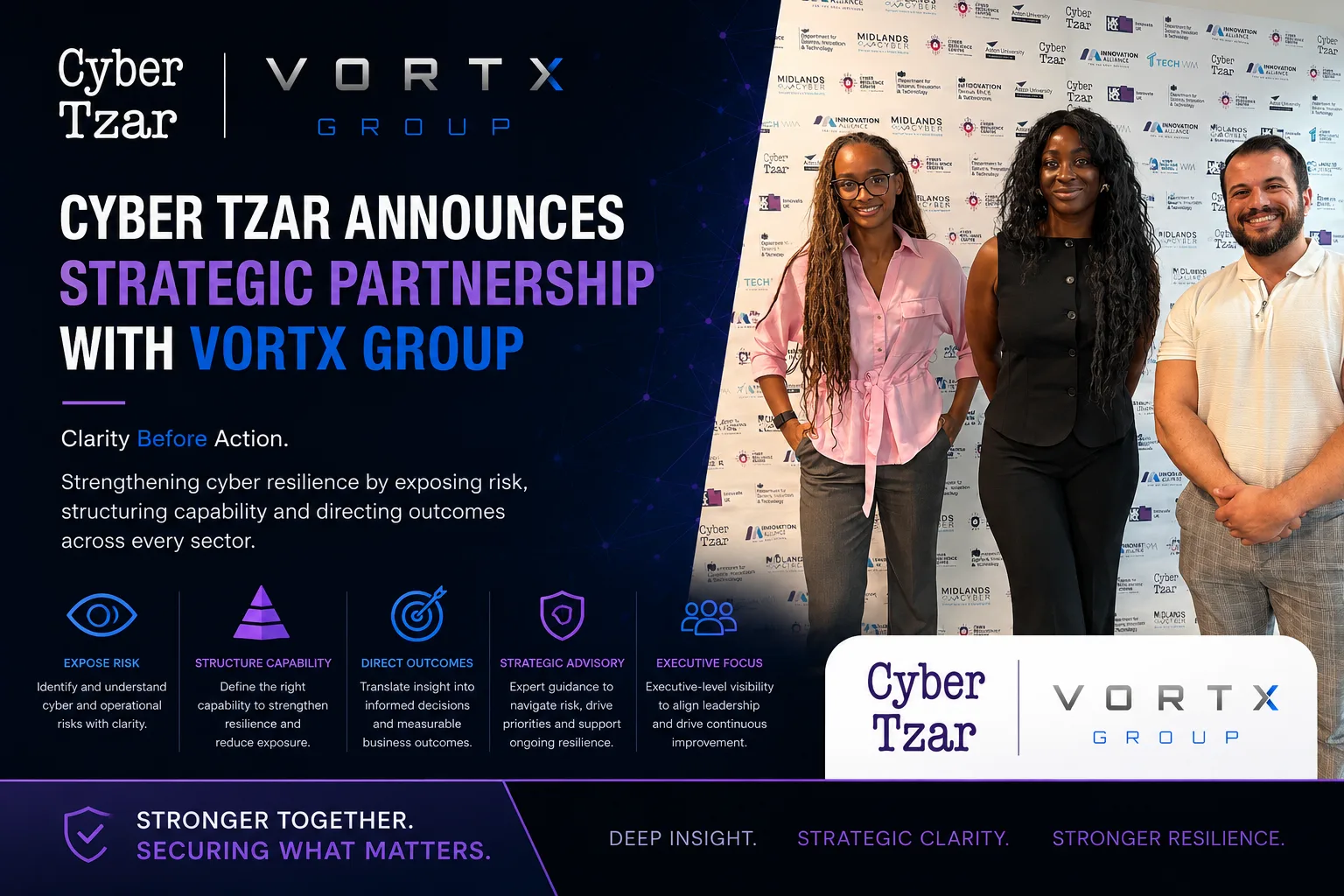
A lot of our growth has happened alongside the development of the West Midlands Cyber Hub and the wider regional cyber community.
What has been especially encouraging is that the momentum has not been unique to Cyber Tzar.
We have seen similar progress from a number of independent businesses based within, or closely connected to, the Hub including Orbital IAM, Cybercy Group, CyberQ Group, Rugosus and others.
Each organisation is independent, with its own customers, ownership, commercial model and strategy.
What the Hub has helped create is an environment where businesses can meet, find talent, build partnerships, make introductions and collaborate more easily.
That, to me, is what a strong regional technology ecosystem should do.
It should not exist to grow one company. It should create the conditions for multiple companies to grow.
For Cyber Tzar, being part of that environment has undoubtedly created valuable relationships, access to talent and opportunities for collaboration. The same is true for other businesses across the community.
Ultimately, though, each company’s growth still comes from its own people, customers, technology, investment and execution.
Seeing multiple businesses benefit from the wider ecosystem is something I am genuinely proud of.
From proving the technology to proving the market
In 2025, much of our focus was on proving the potential of the technology.
Today, the conversation is very different.
Cyber Tzar has progressed paid engagements, pilots and advanced commercial opportunities across enterprise supply chains, financial services, insurance, defence, higher education, public-sector organisations and national cyber resilience.
The important point is that the same underlying intelligence engine can be applied in very different environments.
A university may use it to understand thousands of suppliers. An enterprise may use it to prioritise third-party risk. A financial institution may use it as an additional cyber risk intelligence layer. A public-sector organisation may use it to understand exposure across a much larger supplier population.
The technology is the same. The application changes.
Why Fubra’s backing mattered
Early-stage investment is often judged purely in financial terms.
For me, the more important question is what that investment enabled us to become.
Fubra backed Cyber Tzar at a point where the technology had significant potential, but the organisation around it was still developing.
Their support gave us greater confidence to invest in people, processes, commercial infrastructure and the platform itself.
That does not mean investment creates success on its own.
Investment creates an opportunity.
People have to do something with it.
And that is why the biggest thank you in this reflection goes to the Cyber Tzar team.
They are the people who have turned that opportunity into something real.
Looking forward to 2027
The Cyber Tzar entering 2027 is not the same business that entered 2025.
We have a larger team, a much bigger technology and data estate, a growing reseller network and a commercial pipeline operating on a completely different scale.
The next phase is about strengthening the platform, expanding the partner ecosystem, improving data validation and reporting, and continuing the development of the Universal Cyber Risk Score.
There is still a huge amount of work ahead.
But when I compare the company Fubra backed in 2025 with the business we are taking into 2027, I am incredibly proud of what the team has achieved.
Fubra backed us at an important moment.
The team took that opportunity and built something much bigger.
Now the challenge is seeing just how far we can take it.
Andrew Horkan
CEO, Cyber Tzar